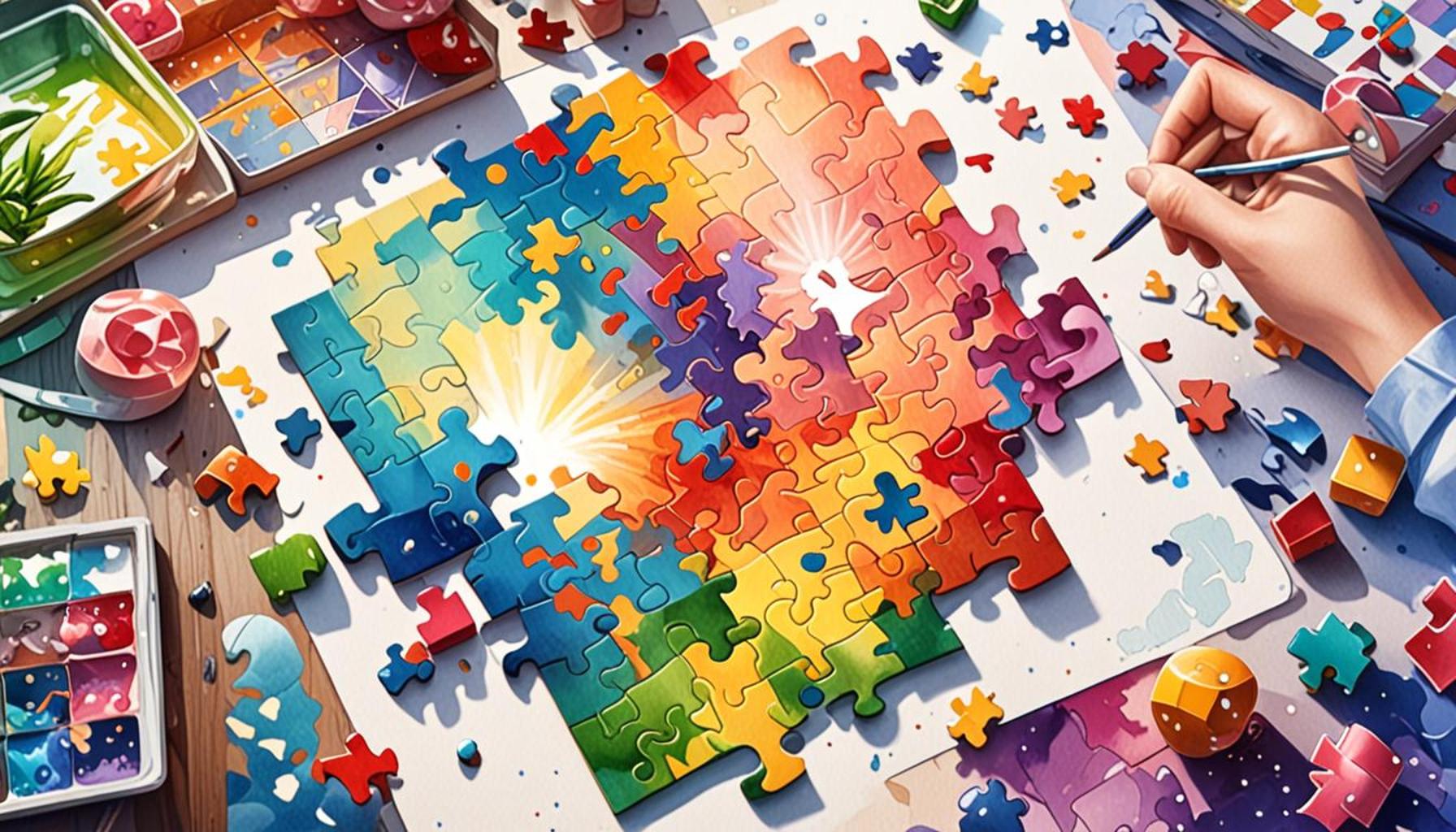
Mathematical Puzzles: Challenging Numerical Memory and Logical Reasoning

Unlocking the Secrets of Mathematical Puzzles
Mathematical puzzles have long captivated minds, offering a unique blend of challenging numerical memory and logical reasoning. These intriguing challenges not only provide entertainment but also stimulate cognitive functions essential for problem-solving. The allure of mathematical puzzles lies in their ability to engage participants across diverse age groups, making them an effective tool for both casual enthusiasts and serious learners.
From ancient civilizations, such as the Babylonians and Greeks, who used basic arithmetic challenges to refine their skills, to contemporary classrooms where educators employ puzzles to enhance learning, mathematical challenges have proven invaluable for mental development. Engaging with these puzzles is not merely a pastime; it is a pathway to cognitive enhancement. Some noteworthy benefits of tackling these puzzles include:
- Enhancing critical thinking: Solving mathematical puzzles requires strategic thought and innovative approaches, which can translate into better decision-making skills in everyday life.
- Boosting memory: Regular practice can improve numerical recall and retention, aiding students and professionals alike in tasks requiring quick calculations or data analysis.
- Encouraging persistence: Challenging puzzles teach the importance of resilience in the face of difficulty; individuals learn to approach problems with patience and a mindset geared toward finding solutions.
Examples of popular puzzles illustrate the wide range of challenges available:
- The classic Sudoku, which tests logical placement and number arrangement, demands keen attention to detail and an ability to think several steps ahead. This puzzle has surged in popularity in the U.S., often appearing in newspapers and apps alike.
- Logical riddles, frequently found in IQ tests and competitive exams, challenge deduction skills and often involve intriguing scenarios that require the solver to think outside the box. These riddles not only engage the mind but can also spark interesting conversations.
- Brain teasers involving arithmetic, such as those that require solving for unknown variables under pressure, not only provide mental flexibility but also encourage quick thinking—an essential skill in various high-stakes scenarios, from academic testing to business meetings.
As you delve deeper into the world of mathematical puzzles, prepare to enhance your mind’s capabilities while enjoying the thrill of discovery. The experience of unraveling these complex problems can lead to a rewarding sense of accomplishment, fostering a lifelong love for learning. One puzzle at a time, each challenge you conquer builds your confidence and sharpens your intellect, making the journey through numbers an ever-evolving adventure.
DISCOVER MORE: Click here to learn about the power of long-term planning in digital strategy games</p

Exploring the Cognitive Benefits of Mathematical Puzzles
Engaging with mathematical puzzles brings about a wealth of cognitive benefits that extend far beyond mere amusement. These challenges have the power to not only sharpen our minds but also enrich our daily lives through enhanced mental faculties. By exposing the brain to a variety of thought processes, mathematical puzzles develop crucial skills such as numerical memory, analytical thinking, and logical reasoning.
As puzzles vary in complexity, they cater to diverse levels of expertise, making them suitable for a wide audience. Whether one is a school student or a seasoned professional, there is always a mathematical challenge to suit their needs. The benefits gained from solving these puzzles can be categorized into several key areas:
- Improved problem-solving skills: Confronting complex puzzles promotes an inclination toward critical thinking. As individuals grapple with various approaches to find solutions, they cultivate a persistent mindset. This mental toughness translates into real-life problem-solving situations, enhancing their ability to tackle challenges efficiently.
- Enhanced focus and concentration: Solving mathematical puzzles requires sustained mental attention and focus. Participants learn to filter distractions and hone in on details, which is particularly beneficial in an age characterized by information overload. This practice can have positive implications for both academic performance and workplace productivity.
- Creativity in mathematical thinking: Many mathematical puzzles challenge conventional methods of solving problems. By encouraging outside-the-box thinking, they empower individuals to approach mathematical concepts with greater creativity. This expanded view not only deepens mathematical understanding but also opens avenues for innovative solutions in various fields.
- Fostering teamwork and collaboration: Engaging in mathematical puzzle-solving can also bolster social skills. Team-based challenges and competitions foster cooperation and communication, allowing participants to learn from one another and share strategies. Such collaborative experiences can strengthen friendships and build valuable networks.
In the United States, initiatives promoting the use of mathematical puzzles can be seen in classrooms and educational programs designed to enhance STEM (Science, Technology, Engineering, and Mathematics) education. Educators recognize the relevance of these tools in nurturing young minds, equipping them for future academic and career pursuits. Events like math competitions and puzzle-solving clubs have emerged, further celebrating the joy of mathematics while cultivating a passion for learning.
As we venture deeper into the world of mathematical puzzles, it’s essential to recognize their profound impact on cognitive abilities and overall mental health. The approach to problem-solving that these puzzles inspire can lead individuals to a greater understanding of mathematics, transforming how they perceive and interact with the world around them. Through this exploration, one may discover that every puzzle solved not only enhances numerical memory but also unveils the deeper connections that exist within the realms of logic and reasoning.
| Advantage | Description |
|---|---|
| Cognitive Improvement | Engaging with mathematical puzzles enhances both memory and logical reasoning skills. |
| Stress Reduction | Solving numerical challenges can be a fun and relaxing way to divert attention from daily stressors. |
| Social Interaction | Participating in group puzzle-solving promotes teamwork and strengthens relationships through collaborative problem-solving. |
| Enhances Problem-Solving Skills | Regular practice with logical reasoning puzzles can improve analytical and critical thinking abilities. |
Engaging with mathematical puzzles not only sharpens cognitive skills but also serves as a stimulating recreational activity. The discipline of attempting to solve these puzzles introduces an element of fun while encouraging individuals to stretch their thinking beyond typical pathways. Hence, this intriguing intersection of enjoyment and intellectual growth leads to a fruitful exploration into the realm of numbers and logic, compelling enthusiasts to delve deeper into mathematical challenges.
DIVE DEEPER: Click here to uncover more insights
Mathematical Puzzles in Popular Culture and Education
Mathematical puzzles have woven themselves into the fabric of popular culture, captivating audiences and serving as both entertainment and educational tools. From movies like A Beautiful Mind, which chronicles the life of mathematician John Nash, to viral online brain teasers that challenge logic and numerical memory, these puzzles spark curiosity and invite individuals to explore the wonders of mathematics. This cultural fascination reflects a broader recognition of the relevance of mathematical thinking in everyday life.
Furthermore, mathematical puzzles are not merely confined to entertainment; they hold significant educational value. Many educational institutions across the United States are integrating these puzzles into their curricula to enhance students’ numerical memory and logical reasoning skills. Programs like Math Olympiads and the MATHCOUNTS competition encourage students to tackle challenging problems, thereby fostering a culture of inquiry and exploration. Through such competitions, students learn to approach obstacles with creativity and collaboration, echoing real-world problem-solving scenarios.
In addition to classroom settings, various apps and online platforms offer a plethora of mathematical puzzles designed to engage users of all ages. Websites like Brilliant.org and Math Playground provide interactive problem sets that stimulate logical reasoning while allowing participants to compete against others worldwide. This avenue not only enhances numerical memory but also fosters a community of mathematics enthusiasts eager to share insights and strategies.
Moreover, research has underscored the educational benefits of mathematical puzzles. Studies show that students who regularly engage with puzzles perform better in mathematics and related fields compared to their peers who do not. For instance, a study conducted by the National Council of Teachers of Mathematics revealed that the application of puzzles could significantly improve students’ problem-solving abilities and promote a deeper understanding of mathematical concepts. In an educational landscape where standardized testing often dominates, the use of engaging puzzles can infuse excitement into learning.
However, the impact of puzzles goes beyond academic achievement. The mental exercise involved in tackling complex challenges has well-documented psychological benefits. Engaging regularly with mathematical puzzles can improve mental resilience, boost self-confidence, and even enhance emotional well-being. Individuals who take on these challenges report a sense of accomplishment and satisfaction, stemming from their ability to navigate intricate problems successfully. This newfound confidence can translate into other academic pursuits and career aspirations, demonstrating the far-reaching implications of engaging with mathematics.
Beyond their individual benefits, mathematical puzzles have the potential to foster a sense of community. Math circles, clubs, and competitions create environments where participants share experiences and learn collaboratively. These interactions not only hone problem-solving skills but also cultivate friendships among like-minded individuals. In a time when social connections are invaluable, the collaborative aspect of engaging with mathematical puzzles can serve as an essential dimension of social development.
As mathematical puzzles continue to gain traction in both educational and recreational contexts, their ability to challenge numerical memory and enhance logical reasoning remains undeniably significant. Through creativity, cooperation, and dedicated problem-solving, they nurture not only a love for mathematics but also essential skills that will resonate throughout individuals’ lives.
DIVE DEEPER: Click here to uncover more
Conclusion: The Enduring Value of Mathematical Puzzles
In a world where critical thinking and problem-solving are paramount, mathematical puzzles stand out as not only a source of entertainment but also as invaluable tools for enhancing numerical memory and logical reasoning. Their integration into popular culture, from films to online platforms, serves to ignite a passion for mathematics that transcends age and background. This cultural embrace highlights the universality of mathematical thinking and its vital role in our daily lives.
The educational benefits of these puzzles cannot be overstated. They provide an engaging alternative to traditional learning methods, empowering students to approach challenges with creativity and resilience. As evidenced by various studies, consistent interaction with mathematical puzzles contributes significantly to improved academic performance and deeper conceptual understanding, particularly in mathematical disciplines. Schools across the United States are recognizing this potential and are adopting puzzles into their curricula, signaling a shift towards a more dynamic and interactive form of learning.
Furthermore, the psychological advantages of tackling mathematical challenges promote not only cognitive skills but also mental well-being. The sense of achievement that arises from solving complex problems fosters confidence and nurtures a growth mindset, crucial traits in both academic and real-world settings. As individuals connect through math circles and competitions, the social dimension of engaging with puzzles enhances community bonds—creating a supportive environment where ideas and experiences are shared.
Overall, the realm of mathematical puzzles offers not just rigorous challenges; it opens up pathways for lifelong learning and collaboration. By embracing the intricate world of numbers and logic, we equip ourselves with skills that are essential for navigating an increasingly complex future. So, next time you encounter a mathematical puzzle, remember that you are not merely solving a problem; you are actively engaging in a transformative learning experience that is as rewarding as it is enlightening.